Friday, April 07, 2006

Deus Caritas Est - Sacramental Mysticism

It is the Eucharist that fulfills this meaning of sacramental mysticism. It is here that we encounter Christ truly, really, and substantially present to us. It is food that nourishes our spirit, that eternal wisdom. Thus, the sacraments, especially the Eucharist, give us the ability to respond to God's love to us. God gives Himself to us in the Eucharist, in which we respond back in praise and thanksgiving through the contemplation of that which we just received, through the contemplation of the Divine Mystery of God's love. This brings us to many realizations about the Eucharist. First and foremost, the Eucharist is something we receive, we do not take. The Eucharist is God's gift to us, and the priest stands there in the person of Christ, thus Christ is giving Himself to us, just as He gave Himself to the Apostles 2000 years ago. As a result of this gift, we exclaim Amen(and it ought to be a joyful exclamation)! Amen means “Let it be so, It is True, I believe”. That is our response to the gift of Christ. Thus, in the Eucharist we experience God's love in its threefold fullness. We receive the healing power of the Eucharist through the grace we receive which helps us grow closer to God in the forgiveness of our sins, hence the inseparability of the Sacrament of the Eucharist from the Sacrament of Reconciliation. Without one, there would not be the other. Secondly, God seeks us out first. The priest says “The body of Christ”. Christ has come to seek us out and make Himself known to us, and presents Himself to us through the priest. Thirdly, God gives Himself to us completely in the Eucharist. We witness the sacrifice of Christ in the Mass which makes God present to us, and we receive that ultimate love, Christ, from that ultimate act of love, His death on the Cross.

That is only the aspect of God's action of love in the Eucharist, we have a loving aspect as well. We go up to receive the Eucharist. We go out to seek God. Our hearts yearn for that truth which is made present to us in the Eucharist, it is what we truly long for and yet, it is something we cannot attain on our own. Thus God comes down to us so that we may receive His love. God gives Himself to us when we seek Him, because He seeks us first. When it comes time for us to have the privilege of receiving our Lord in the Blessed Sacrament, we make some sort of act of worship before reception. This is that outward sign of that interior reality. We have faith that what we are to receive is Christ, and we make that know by bowing, genuflecting, or making the sign of the Cross. This is our act of love to God, acknowledging Him for Who He is. Then the priest says “The Body of Christ” and we say Amen. We thus give ourselves over to God through that act of faith made known through our exclamation of Amen! Thus, love between man and God is comes to it fullness in the Eucharist. We participate in that heavenly reality right now and thus also have a foreshadowing of what Heaven will truly be like. The liturgy is an experience of Heaven, and Heaven, as is experienced through the liturgy, is a communion of love between God and His creation. There is much, MUCH more to say on this aspect of the encyclical, but that could take nights up nights to discuss. I highly recommend you go out and read it for yourself to see these truths which our Pope speaks of with regards to the Eucharist.

-Harrison

A Much Needed Night Off

Well, I finished my last class at the University of Victoria today. I now only have to do my final exams and then I will have my BA in Philosophy...I can see the companies calling me up right now begging me to work for them *cough* *cough*....:)

Anyways, because I'm taking a night off from all that cramming and studying, I have an interesting article for you all. In it, Cardinal Francis Arinze is calling on priests to put the tabernacle back at the center for the Church as a means to restore reverance for Christ's presence, that Christ is there for all instead of off to the side...interesting.

Here's the Article

http://www.catholic.org/international/international_story.php?id=19348

Thursday, April 06, 2006

To Do List for April

Well, it's my last month of school. In fact, tomorrow (Friday) is my FINAL day of classes at the University of Victoria EVER! Of course, though, there are still exams, but it is a step towards that light at the end of the tunnel. And yet, there is still much to do this month:

-Finish paper on Frege and Ockham on Truth. For those of you who are medievalists out there (and I know there are), Ockham is going to blow Frege out of the water with regards to the theory of truth as it relates to language. Ockham's theory of supposition and signification are ingenious. This is one of the better papers I think I have ever written, it is a point of seeing whether my prof will think so. Due Monday, but want it done for Friday.

-History in Byzantine Art Final Exam - Friday. Worth %15 of my mark, and it shouldn't be too hard.

-Go out Swing Dancing on April 7th and April 22 & 23 at the Victoria Hot Jazz Festival. Apparently dancers will only be having to pay $20 for those two days!!!

-Philosophy of Truth exam, Tuesday, the 11th at 9am. Glad it's the first one because it's been a painful class.

-Chrism Mass on Tuesday...have drinks with clergy and Bishop and serve them dinner, and then go to the Chrism Mass.

-Work and Holy Thursday, parents are also coming over that day.

-Good Friday...pray, fast, go to Good Friday Service.

-Holy Saturday - Go to Vigil

-Easter Sunday - Go to Mass

-Easter Monday - Work

-April 21st - Rationalist Philosophers Final - 7pm

-April 28th - History of Intellectual Thought in the Middle Ages final - 7pm. Rejoice after exam because I will never have to step foot on that campus for a class ever again.

-FIND A JOB!!!! (Interced for me St Joseph the Worker).

That is all...it's a busy month indeed. And that's only the important stuff! Needless to say, as much as I love learning, I'm looking forward to just working and making money and relaxing and reading what I want to read for a while :).

-Harrison

Deus Caritas Est - The Newness of Biblical Faith

The Jewish faith at its beginning made some pretty bold claims. The boldest claim was that the God of Israel is indeed the One and Only God, that there are no other gods, but that He alone is God. Thus, unlike the pagan religions, which explain creation as a result of war and strife between the gods, there is only one God who created the heavens and the earth. If this is the case, then it follows that creation is not a result of hate and division, but it is a result of a God who cares and loves that which He created. His love is also elective in that he chooses the Israelites for the sake of saving all humanity in the end. It is thus in God's choice that his love is seen in both the light of eros and agape. He seeks, but He also gives of Himself. It is out of God's love that He gives His people the Torah to open their eyes to the truth of Himself. Thus we see where the true humanism of man comes in. It comes through the finding of one's identity through one's relationship with God. Man is truly himself through the relationship of love that he has with God.

Agape, in its dimension within the reality of God's love, goes so far beyond self giving that it includes forgiveness. It is in the sin of man that God reveals His love at its fullness, that self-giving love includes forgiveness, and this can be seen from numerous examples in the Bible. This is the centrality of Christ's death on the Cross, that God loves humanity so much, that He would turn against Himself by becoming man, and thus, through His death, reconcile justice and love. Thus, God is indeed love, just, and forgiving.

From this image of God, we come to the image of man. For the sake of time and the fact that this will be discussed at a later time in our talks on the Theology of the Body, I will simply say the following about this. Eros is rooted in our nature, that we man is incomplete without both male and female, hence why it is not good for man to be alone. Man, in his nature, is a seeker of a communion of persons. Thus, it is this communion of persons that define who we are, and it is this communion of persons that we are made in the image and likeness of God.

This brings us to Christ, who reconciles the rift sin made between God and man through God becoming man in Christ. It is Christ who makes present to us in a very real way the true meaning of eros through the incarnation so that He may come to search out the lost sheep. It is this seeking that is the center of all the parables, such as the woman looking for the lost coin, and the shepherd going after the stray sheep. And this is all realized at the Cross when Christ's side is pierced. It is here where we see God turning against Himself, it is here that we see man raised to a new life never before imagined, through the participation in the Divine life. Yet, this is something that cannot be achieved blindly, nor intellectually. We come to realize this through contemplation.

Wednesday, April 05, 2006

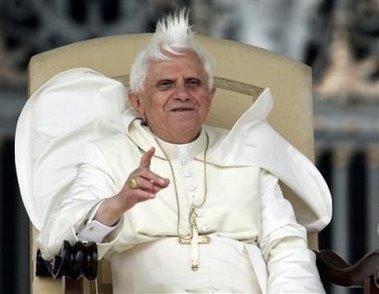
Best Pope Picture Ever


I really think this is the best picture ever. Cute, fun, and just shows the lighter side of the faith, that God indeed does have a sense of humour. Thank you to American Papist for posting it. He's got a few more from a gusty Wednesday Audience.

Speaking of Wednesday Audiences, I hope that his audiences will be published one day as are the ones of John Paul the Great. He's got some great stuff, but because we get the shortened version in english, it'd be nice to see what he has to say in full.

-Harrison

Deus Caritas Est - Erotic Love Part 2

The problem of our culture today is that it sees agape love as Christian love, since it is self-sacrificial and rooted in our faith in God. Erotic love, however, because of its possessive nature, is seen as distinctively non-Christian. However, the Pope says, despite these two seemingly opposing points of view, there is a unity in these two types of love. The more these two aspects of love find their unity in the overall reality of love, the more the true nature of love is realized.

It is eros that leads us to agape. It is through eros that we begin our search for happiness, and our intentions become less and less self-centered, and thus grow gradually to a greater selflessness, thus the entering of agape. And agape itself cannot survive on its own. Man cannot constantly give, but he must receive as well. Receiving is an act of love, it is an affirmation of the love shown to you, and thus the agape love leads to the love of eros. Both types of love are totally and utterly dependent on each other. Without each other, love is not at its fullest, but is incomplete. The Pope is saying something very important here; that it is good to receive and bad to just give. Love is an act that involves two parties. Love must also be reciprocated. Thus, when one gives love, another receives, and, as a response to that reception of love, one gives back. Love is thus a communion, which is the very inner life of the Trinity. Therefore, love must contain both the love of agape and eros. This is exemplified to us through Jacob's latter and its interpretation by the Church Fathers. They saw Jacob's latter as a metaphor for love, of our seeking God (eros), and receiving God's love (agape). The ascending of the latter was the seeking of God, while descending was the reception of that love.

Thus, the Pope concludes, love is a singular reality, with various dimensions that emerge more clearly to us as we are purified by God's love. Love, however, can be mistaken when it's various dimensions are separated from each other to appear as though they are very distinct realities, and thus the true idea of love is impoverished and incomplete. The Bible speaks to the truth of the human experience of love, and this is expressed in the Song of Songs, in which the first part expresses the seeking of love and this seeking is fulfilled through the giving of self. Thus love can only be fulfilled when the twodimensions of eros and agape are seen as dimensions of the same reality of love. This now brings us to our biblical faith. We must now put these aspects of love into context of the image of God and the image of man

Tuesday, April 04, 2006

Deus Caritas Est - Erotic Love

The modern interpretation of erotic love is a response. It is a response to what is perceived as the Church being opposed to the body. The Church has never opposed the body, but has defended it.

However, due to these false perceptions, there has been a false response. The view of society nowadays is to say that it is the body only that is important. Hence erotic love in our culture is seen in the light of pure sex. This is why we have a culture of death and a culture of sex. It is a false response to what is a false perception of the dignity of the human person. If we do not recognize the great dignity of man shown through the unity of body and soul, then people will view a baby in the womb of his or her mother as a simple fetus, a grouping of tissue, and will view pain as burdensome, and will view physical pleasure as the only means to happiness. The body is made to express our entire being, but nowadays it expresses only that physical aspect of our being, and thus is incomplete and devoid of the dignity that is due to the human person. This is the erotic love that needs to be purified. Erotic love indeed does lead us to the divine, into an ecstasy that leads us beyond ourselves. However, it must incorporate our entire selves, and not just a singular aspect.


So then, how are we to experience erotic love so that it can be fully realized? What is this process of purification that is needed to experience erotic love in its fullness? Love is a process of discovery of the other. It is a movement away from the self and towards giving completely towards the other. As we discover the other, our motives for loving the other change. While love in its initial stages is on the more insecure, self-seeking level, it grows towards a more self-giving level in which one's personal goals and aspirations are put to the side for the other. Love becomes totally self-sacrificial and self-giving. This move towards the other is a move from the temporal to the eternal. We move away from our own immediate desires towards the wanting of eternal care and happiness for the other, thus why love has that meaning of “for ever” stamped into its nature. Love looks to the eternal. Thus, love is ecstasy, in that it is an on going move from the immediate self towards the eternal self-giving. This finds its completion in the eternal Other, God, who we give ourselves eternally to Him, and where we find our true ecstasy, our true love, our true end.


We come to realize, now, that love cannot stop at the human. If love is supposed to bring us to the eternal, then man cannot do this alone. Indeed, God, as stated, is the true end of our love. This thus brings us to biblical faith.

Monday, April 03, 2006

Deus Caritas Est - Definition of Love

Love raises many questions for us. Who is this God who loves us without end, and who are we that God would love us so? But if love defines God and defines us, then what do we mean by love? Perhaps the most common use of love in society, since society is increasingly turning away from God, is the love between a man and a woman. This love, which intimately unites the man and woman in the lifelong bond of marriage, is an intimate union of body and soul in one flesh. This seems to be that epitome of love to us, all other types fail in comparison. Do these other types of love have something in common, do they designate the same reality, or are they all different realities in which there is no commonality. This is the Pope's purpose in his analysis of love.

We must now define some terms. There are three Greek words for love that are mentioned in this encyclical and they are as follows:

Eros means erotic love, love that leads us in ecstasy to the Divine, but is worldly, ascending

Philios means brotherly love (think Philidelphia).


Agape means self-sacraficial love, a love that is grounded and shaped by faith


The Pope analyzes Eros and Agape, while he puts Philia to the side. Eros, the Pope says, which is the most frequently used word for love in Greek, is rarely used in the Bible, while Agape, which is rarely used in the Greek language, is the most commonly used word for love in the Bible. So, the Pope asks, are Eros and Agape mutually inclusive or mutually exclusive?


Eros, in the time of the Greeks, was considered as something that overpowers the reason, in which the physical pleasures one gets out of erotic love take over and the spiritual side of love is completely forgone. It is this almost overpowering feeling that erotic love brings that it became to be considered a Divine thing, as a god in and of itself. However, we do not worship a love that overpowers our sense of reason. Love does not overpower, it empowers.


Now, this is not to say that erotic love does not have a place within the Christian faith. Erotic love indeed does have a place, it, however, has a warped understanding, and its true understanding can only be found in God Himself. Thus, there is a relationship between erotic love and the Divine, though it has been warped by many people throughout history. Love indeed does promise much, but our love must be purified and we must grow in maturity. This purification and promise of infinity indeed heal and restore the true meaning of erotic love.

Now, man is made up of body and soul. If we are to hope to attain a purely spiritual existence, then we lose the dignity in being created in God's image, but if we hope to attain a purely physical existence, which, in the end, is existing like the animals, then we lose the greatness we were made for. Man is not to be physical only, nor is he to be spiritual only, man is body and soul, and it is in this unity that man finds his dignity being made in God's image and likeness. It is thus the complete picture of man that loves, our love cannot come from just one aspect, but must involve our whole self. It is in this that erotic love is able to mature and become authenticated.

Saturday, April 01, 2006

Conservative? Liberal?

I promise, last post for the night. But there has been an interesting discussion apparently at the Catholic Educator's Conference down in LA and one of the main topics at one of the Q&A sessions has been the application of political terminology to the teachings of the Church. So, what terms can we use? Liberal, Conservative, Right, Left, Orthodox? I offer you the following argument from my comment at the dotCommonweal blog on this topic:

http://www.commonwealmagazine.org/blog/post/index/146/Healing-divisions#cmt

I have never been a big fan of using political terms to describe Catholic positions. Political language does not suffice to describe Catholic beliefs because the terms used in political language tend to change.

While it is true that certain teachings of the Catholic Church do refer to political aspects as well, and thus a similarity between the two, the motivation is quite different. In the political sphere, it is one's personal ideals and the party line that enables a person to go towards the right or the left, to be a liberal or a conservative.

The motivations of the Church, however, are not some political ideal, we are not, as Pope Benedict says, Christian's because of some lofty idea or ethical choice. The motivations of the Church are a result of that encounter with Christ that the Church has been participating in for nearly 2000 years. Thus, the motivations are truth, justice, and the good. The motivations are to defend the truth which is Christ, and the truth does not change with the winds of time, but is constant and always present.

For a political party, political ideals can change over time. Furthermore, we must remember, that there are certain teachings of the Church which would be, in the political sphere, be considered conservative, while other teachings (ie the Church's social teaching) are on the more liberal side. But these terms do not satisfy the meaning of the teachings. If we apply these political terms, then the teaches are no longer rooted in the truth, but in the ideals of a society in its current state, able to change over time.

The truth does not change, it is constant, and eternal, and is made known to us through our encounter with Christ. Thus, we have orthodox beliefs in the Church and those who do not follow Church teaching in way that is not good for the sake of their soul are considered to be heterodox. Those are the only terms which we can apply to the teachings of the Church. They satisfy the meaning of the teachings, because Orthodox means, simply, right belief, while heterodox means wrong belief. There is a truth and a falsity, and Christ is the truth, and thus our teachings are based in that truth. If our teachings are based in the Truth of Christ, and we have faith in Christ (that is, we believe in Him), then the only term that can have any meaning with regards to the Church's position is Orthodox.

-Harrison

Some Articles to Check Out

I'm posting a bit more today simply because I'm taking a much needed "night to catch up and do things that aren't related to crappy philosophy subjects." And so, I give you some articles.

These articles come from a bi-weekly e-mail I get from CERC - the Catholic Educators Resource Center. Here is the link:

http://catholiceducation.org/

It is a great site headed by my friend's dad, Fraser Field. It is great for any Catholic out there, as he gets together articles from all over the place and posts them in his bi-weekly e-mail. Please check it out!

Here is a brilliant defense of politicians who truly practice their faith making use of it in their daily life. Rex Murphy argues that there is nothing wrong with Stephen Harper saying "God Bless Canada", but that it is, instead, something comforting.

http://catholiceducation.org/articles/civilization/cc0209.html

Here is an article which I read a few weeks ago, but is apart of this e-mail, from George Weigel. First and foremost, come to hear George Weigel speak at "Discovering the Catholic way of life" here in Victoria. Information is available at: www.standrewscathedral.com . He writes a BRIEF (and I do mean brief, 4 paragraphs to be exact) overview of Pope Benedict's first part of Deus Caritas Est. I'm glad I ran across it because it'll help me see some overarching themes so that I can shorten my talk down. Check it out:

http://catholiceducation.org/articles/civilization/cc0210.html

John Allen gives us a general overview of Pope Benedict's first year. It is a long article (I will be reading it in pieces, the stuff I've read so far is very good), but well worth the reading:

http://www.nationalcatholicreporter.org/word/

I hope you enjoy the articles.

-Harrison