Here is a recent article that was published in our National Post.
http://www.canada.com/topics/bodyandhealth/story.html?id=e5dad385-c1d5-4ae2-9681-8aa188f5496a&k=76351
Reading this article infuriated me, not because of its conclusion, I think it is great that there are less pregnancies among teens. However, it is the way they attempt to support, by saying that it is a contraceptive world that has brought this about. Needless to say, this article, I found, to be completely lacking in the realm of reason and so felt that it would be necessary to reply to the article by writing a letter to the Editor and this is what I wrote:
The article on Teen Pregancy in Canada is a perfect example of the logical leaps that people make, all in the name of what they believe to be is reason.
You suggest that because sex-ed and contraception is more readily available, and that teens are roughly having sex at the same rate, that therefore it is the logical conclusion that it is because of sex-ed and contraception that is leading to less pregnancies.
This is a faulty conclusion. Just because it is more available does not entail that it is the main cause of less pregnancies among teens.
You never mention once that while many teens do indeed have sex (something the article is more then willing to make known), you never mention once the increasing movement of teens embracing a life of abstinance until marriage. The article simply says, albeit vaguely, that "it (the result of less pregnancies) does not mean teens are less sexually active or routinely engaging in safer sex."
And yet, while the article is steeped with statistics to make its point look valid, it has no statistics on the result of teens having sex, it just says that they are.
I think it is unfortunate that Canada has gone so far off the track that it is no longer able to look at things in a reasonable manner, but instead cites statistics and experts for the appearance of reasonableness without applying the facts to reason itself.
-Harrison
Thursday, May 17, 2007


Wednesday, April 25, 2007
Veluti si Deus Daretur
I just began reading "Christianity and the Crisis of Culture" by BXVI (Just finished "On the Way to Jesus Christ, it is amazing, READ IT!)
Anyways, I just read the introduction and Marcello Pera, the person who wrote the introduction, comments on one of the things the Pope says. Back in the day, it was said that we should act in a way even if God did not exist, but that we must now live as if God did exist.
The former is a Pascalian view of the world...it is better to act even if God does not exist, it is a better wager.
But the Pope challenges us differently because the world has changed since the time of Pascal. The Pascalian view is no longer valid in a world that no longer believes in God. If you tell them to act even if God did not exist, they would put you to the side, because they would say that God indeed does not exist.
This new proposition being made now is fundamentally different. The challenge to the world is "Act as if God does exist". This is a more positive view of Pascalian way, but does have it's subtle differences for the better.
Mr. Pera puts the challenge that this is what we are to propose to the world, that they ought to act in a manner as if God does exist, and that this is the proposition to make to those outside the Church.
My question is, however, how is this possible? How can we convince people that this is a proper view of the world and one that is reasonable enough that one would be willing to live by it regardless of what they believed.
Please let me know what you think.
Friday, April 13, 2007
Christianity in Society
I have been doing some reflecting lately on the role of Christianity in Society.
I have been wondering what it is that is the fundamental thing that people have problems with in Christianity. Is it the morality? Is it how we feel about the role of faith and reason? Is it our view of the dignity of the value of the human person?
I think Pope Benedict gives us a good hint in Deus Caritas Est. He states
People love attaching themselves to Christianity in a fuzzy sort of way. People have no problems with lofty ideas or value systems in essence really. The reason why that is is because it falls into the realm of tolerance and relativism. A value system is fine when there is no motivation for it to convince others, it is good for you, and people appreciate that. People feel nice when they have something to guide their life and their actions. It is the same with the lofty ideas. Prayer is fine when it doesn't intrude on others, when it is only personal and internal, where you and God can relate in a way that is appropriate to you only and not to others. Prayer, of course, is certainly very personal, but we know from our Christian experience that this is not the case.
You see, it is the second line of what Pope Benedict says that makes Christianity unique and unpopular. Christianity is not about values, lofty ideas, mystical experiences, at least not in and of themselves. In and of themselves they do not bring meaning to life. Instead, they just give direction, but direction and meaning are two totally different things.
What Pope Benedict is suggestion is that we have faith in a person, in Jesus Christ, in that faith, the reason for our humanity will be made clear. Our life will be given direction and meaning and purpose.
So, there is a reason why Christians get sick to their stomachs when they see books about Christianity, but only go so far as to say that Christ was a good man, but He wasn't God, and He didn't resurrect from the dead. It is simple, without the resurrection, then our faith is a dead faith, with nice ideas, but nothing convincing to it.
People have no problem saying "I like Christianity, but I can't claim Christ to be my Lord and God because He isn't, that is just too much for me". It is the truth.
I came to realize this past Triduum the true awesomeness of the Resurrection. He is not dead, He is indeed risen. Christians who are convinced of that see that Christianity is meant to inform and change their lives. It is part of their very being because they encounter the risen Christ in everything.
People don't like Christianity because they can't come to believe that Christ is truly present in the world. But He is, He is a reality to the world. And that is why people shy away from it. If one takes Christianity seriously, they have to accept the fact that Christ is alive and well and His love is being poured out to those who accept it. Christ becomes a part of their life and they come to discover Christ in their life on a day to day basis for the rest of their lives.
Those who like Christianity as an idea or a way to encounter God whom they feel transcends religion and is the same for all don't go to the extent that a Christian does. They can't get past the idea that Christ is truly risen.
Without the resurrection, our faith is dead. Thanks be to God that He is truly risen!
-Harrison
I have been wondering what it is that is the fundamental thing that people have problems with in Christianity. Is it the morality? Is it how we feel about the role of faith and reason? Is it our view of the dignity of the value of the human person?
I think Pope Benedict gives us a good hint in Deus Caritas Est. He states
Being Christian is not the result of an ethical choice or a lofty idea, but the encounter with an event, a person, which gives life a new horizon and a decisive direction.
People love attaching themselves to Christianity in a fuzzy sort of way. People have no problems with lofty ideas or value systems in essence really. The reason why that is is because it falls into the realm of tolerance and relativism. A value system is fine when there is no motivation for it to convince others, it is good for you, and people appreciate that. People feel nice when they have something to guide their life and their actions. It is the same with the lofty ideas. Prayer is fine when it doesn't intrude on others, when it is only personal and internal, where you and God can relate in a way that is appropriate to you only and not to others. Prayer, of course, is certainly very personal, but we know from our Christian experience that this is not the case.
You see, it is the second line of what Pope Benedict says that makes Christianity unique and unpopular. Christianity is not about values, lofty ideas, mystical experiences, at least not in and of themselves. In and of themselves they do not bring meaning to life. Instead, they just give direction, but direction and meaning are two totally different things.
What Pope Benedict is suggestion is that we have faith in a person, in Jesus Christ, in that faith, the reason for our humanity will be made clear. Our life will be given direction and meaning and purpose.
So, there is a reason why Christians get sick to their stomachs when they see books about Christianity, but only go so far as to say that Christ was a good man, but He wasn't God, and He didn't resurrect from the dead. It is simple, without the resurrection, then our faith is a dead faith, with nice ideas, but nothing convincing to it.
People have no problem saying "I like Christianity, but I can't claim Christ to be my Lord and God because He isn't, that is just too much for me". It is the truth.
I came to realize this past Triduum the true awesomeness of the Resurrection. He is not dead, He is indeed risen. Christians who are convinced of that see that Christianity is meant to inform and change their lives. It is part of their very being because they encounter the risen Christ in everything.
People don't like Christianity because they can't come to believe that Christ is truly present in the world. But He is, He is a reality to the world. And that is why people shy away from it. If one takes Christianity seriously, they have to accept the fact that Christ is alive and well and His love is being poured out to those who accept it. Christ becomes a part of their life and they come to discover Christ in their life on a day to day basis for the rest of their lives.
Those who like Christianity as an idea or a way to encounter God whom they feel transcends religion and is the same for all don't go to the extent that a Christian does. They can't get past the idea that Christ is truly risen.
Without the resurrection, our faith is dead. Thanks be to God that He is truly risen!
-Harrison
I'm Back
I'm back, up and running.
I have great news to share too. I just received my acceptance letter to the Tertio Millennio Seminar on the Free Society yesterday which means I'll be going to Poland for July to learn from the greats such as George Weigel, Michael Novak, and Fr. Richard John Neuhaus. God has blessed me indeed, and this has been a very humbling but exciting bit of news for me :).
I hope to be posting more often once again.
-Harrison
Tuesday, October 24, 2006
Why Ockham isn't a Nominalist
He is a terminalist. I know a LOT of people fall into the error of seeing Ockham as a nominalist...but it is impossible when one looks at his writings.
A nominalist is someone who sees a lack of universals, that it is not objective forms that give things their nature, but the words that we give them. So, a nominalist would say that when they see what most of us know of as a book, the meaning of what a book is is up to what he decides to call it. It's the word that gives meaning, it has nothing to do with the reality of the thing itself.
So, in order to over this quickly, I will give a very quick crash course in Ockham's thought.
Ockham believes in the existence of terms and believes they correspond to reality. I will start from the lower and go up to the higher level, as he has a definite hierarchy of terms.
The lowest is written terms. Written terms signify (they point one towards) spoken terms. Spoken terms signify mental terms. Now this is where people think that Ockham stops. That it is mental terms that give meaning to everything. But in fact there is one more level of terms...the term itself, that is, the idea of what the thing is. This is what is not expressible in any sort of language, whether it be written, verbal, or mental, it is pure idea. It is this idea that corresponds to reality. Thus the term as such gets its meaning only from the thing to which it corresponds to. Thus the term of what a book is, the idea of what a book is to use a different word, is only meaningful because there are actual books out in the world to correspond to. Thus there is a meaning in his language.
And multiple objects can participate (to use a platonic word) in the common idea of book. There are objective universals out there in which one can get the idea of book as the particular idea of a specific book, for example, signifies the universal idea of book, it points towards that universal idea of the book. It, in a certain sense, corresponds to that objective reality.
Any comments on this? Am I clear?
-Harrison
Thursday, October 12, 2006
LibraryThing
I couldn't help it! I had to get on this thing! Needless to say it is a great way of keeping track of one's books. I've got 2 shelves of books on there already, only 13 to go. I'm especially fond of the tagging feature. It has gotten me very excited about my book collection and helping me see what I have on my bookshelf that I have forgotten about.
Here's my profile...if you have it let me know and I'll add you to my list on librarything and check out your library.
http://www.librarything.com/catalog.php?view=lindyholic
I should be posting a bit more as time goes on now...life SEEMS to be slowing down. I'm hoping to post, either tomorrow or on Saturday, a post on why Ockham is not a nominalist.
Harrison
Thursday, October 05, 2006
The Intellectual Movement
I've been inspired by the words of the Pope's talk at Ragensburg. And it made me think of to where we see the greatest intellectual movements in the history of man. And sure enough, they all fall within 3 great periods. The following is from an e-mail I sent to a friend...May we all embrace Faith and Reason.
When one looks back at history, one sees the greatest achievements in history in times in which Faith and Reason are embrassed in their fullest. It is interesting to note to that the great cultural movements of Western History are all surrounded with the creation of schools.
The first period is the Patristic Period...in which the great Fathers of the Church defended the True Faith not using just Faith (as many of our Protestant brothers and sisters think) but with Reason. The greatest, of course, is St Augustine who states that belief is what gives rise to a proper use of reason. As St Anselm, in the later Middle Ages states "I believe so that I may understand". Faith is, of course, first, but faith is NOT irrational, but is in fact purely rational...for the Divine Logos, the Word, the Divine Reason, Christ, came down to Earth and took on human flesh. It is in the Incarnation that Reason and Faith come together...for before Christ, we see great thinkers like Plato and Aristotle who attained great truths with the use of reason, but were not able to come to THE TRUTH without the aid of faith. Now, it is easy to note that there were no "schools" during the Patristic period...things were still too scattered, but there were great centers of thought, especially in the East. The school was in the Church, in which the great homilies were given by the greatest of Saints. It is no surprise that St Augustine is ALWAYS studied as one of the greatest minds of history. St John Chrysostom, the Golden Mouth, taught people in the setting of the Church and through his writings as well...it was not in a formalized school, but the Church existed to educate those in the faith they accepted.
The next period is the 9th century Renaissance which, in my humble opinion, begins on Christmas Night in the year 800 in which Charlemagne, Charles the Great, or, as I lovingly call him "Chuck" was crowned by the Pope as the Holy Roman Empire. This was the light that the West needed. There was no such thing as a "dark ages", for that implies a total lack of advancement. Indeed, the period between 500 and 800 AD had less achievements, but that was due to the isolation of towns. There were still great thinkers like Boethius and Pseudo-Dionysius who had a great impact on thought in the Western Tradition, but I am getting off my topic here....
Chuck saw a problem. He saw lack of education in the clergy, he saw a lack of use of the gift of reason in the people in general in fact. It is thanks to Chuck that the idea of a formalized schooling system first comes into place. Chuck is responsible for the creation of the Liberal Arts...the study of Mathematics, Philosophy, Geometry and so forth, in which the Liberal Arts came under 2 titles, the Quadrivium and the Trivium (4 and 3 respectively). In order for the proper training of the priests, Chuck created the ideas of Cathedral Schools, the first VERY formal schooling system (though it MAY be possible to prove me wrong on that, but I argue for it). It is thank to him that we have Capital and minuscule letters in our alphabet and spacing in order to have a better flow on our page...there were numerous other advances as well, including an embracing of Classical thought and a re-immergance of the copying of scripts, to which we can thank for many of the books we have in our possession nowadays.
The next period is the 12th Century Renaissance, and guess which intellectual institution takes its rise from this great cultural advancement? The University. THe ideas of Law (to which the University of Bologna was so popular for), the philosophical and theological and many other traditions have their roots in the University. In fact, it's because our legal system has lost its roots in the Western idea of law (to which BXVI has been warning us so drastically about, the distancing ourselves from our Western roots) that our legal system is now in trouble, because it is so far beyond its original purpose.
The ideas about just wages, fair trade, and many other ideas we take for granted all have their roots in the 12th Century Renaissance, to which was all formed in the, you guessed it, the intellectual sphere of the University. It is there that ideas were formed and molded and put into practice. The thinkers formed the ideas for the way to live life for everyone. And this was all done in the name of truth.
In fact, the greatest common thing between these 3 periods is the fact that there was one common purpose: To discover the Truth in all things, because God who is the Logos, the Divine Reason, came into the world, and so, necessarily, there is a reason to everything in the world. By faith in the Logos, we use our reason to come to the great truths of everything.
I argue to that our society has yet to see such a remarkable and exciting time as those 3 periods. We can reach it again, if we listen to the cry of Pope Benedict, and unite ourselves in our true Western Roots, which is the Divine Logos, and thus would be able to pursue, once again, reason through the guidance of faith in the Truth, which is Christ and His Church.
-Harrison
Monday, October 02, 2006
I've been Tagged
I have been tagged to do this, so here I go...
"If an angel could take me back in time, what five things or occasions would I like to experience?"
5 - To be in the same room as St Augustine as he wrote his Confessions
4 - To be at a class at the University of Paris in the 12th century
3 - To have been able to hear the preaching of St Francis
2 - To have a theological discussion with Bl. John Duns Scotus
1 - To be present for the Crucifixion and Resurrection of Christ (you can't have one without the other)
I can't really tag anyone because I don't know who else who has a blog who reads this.....
-Harrison
Saturday, September 30, 2006
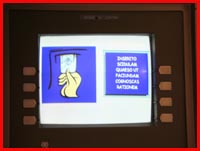
Latin ATMs
Yes...an ATM that's in Latin...
Since the Church's official language is Latin, guess what language their ATM's are?
http://www.cardinalseansblog.org/wp-content/uploads/2006/09/atm-in-latin.jpg
This is courtesy of Cardinal Sean's blog...a great blog worthy to check out.
-Harrison
Since the Church's official language is Latin, guess what language their ATM's are?
http://www.cardinalseansblog.org/wp-content/uploads/2006/09/atm-in-latin.jpg
This is courtesy of Cardinal Sean's blog...a great blog worthy to check out.
-Harrison
Tuesday, September 26, 2006
Discovering the Catholic Way of Life Wrap Up
So, the weekend is now over, and though I'm exhausted, I can't seem to be able to sleep at the moment, so this is a good time to give everyone a wrap up of the weekend's events.
Being a Director of The Edith Stein Society (www.edithsteinsociety.ca), I was quite involved in the weekend.
Friday began with dinner with George at Moxie's with some of the other directors. The dinner was good, though we were a bit quiet...I'm just trying to get used to figure out how to talk to people I don't know...definitely something to grow in :).
After dinner we went for a bit of a walk around the block at which point we made our way to the Conservatory of Music. Sat around, met up with people, and then the conference began with what it means to be a Church.
By far this was my favourite talk of the evening, in that there were 2 important keys to take away, that the Church is a communion and that it is firstly formed in the image of Mary. Amazing stuff and just awesome. We had question and answers and then that was it.
After such an awesome first session we went out to Boston Pizza which didn't work out as much as I was hoping. People still seemed to enjoy themselves, but I was hoping (and so was George after talking to him) that there would have been a bit more of an intimate atmosphere. In the future, I will hold it at the Parish Center.
I drove George back to the Hotel, had an awesome chat with him, and then went back to Boston Pizza for more hanging out, and that was Friday night.
Saturday started off with Mass and then it was the Conference again. Again, awesome stuff. George discussed the Moral Life and the Laws that Liberate. The big thing to take away again was "Morality is where God's will meets the man's will and man's will meets God's will."
It was then off to lunch which involved myself, Annette, and her cousin running around doing some final erands for the conference.
The afternoon was the role of the Church in forming society through Democracy and promoting the culture of life. I know this is George's big thing and that was very engaging as some of it was very new to me and I quite enjoyed it.
And then the conference ended and I've gotten nothing but AMAZING feedback and thank yous and thank you cards for the members of the society. All in all an awesome conference.
Saturday night involved going out for dinner in style with George. And when I say in style, I really mean it. It's one of those restaurants where your meal is small but REALLY expensive. The food was delicious, I just wish there was more...when I hear "4 oz. of prime ribs" on the menu I freak out ;).
Discussions were great and I know Georege really enjoyed the dinner as well.
I got some exciting news that evening as well.
So we were all talking at the table and very much enjoying ourselves. And I was talking for a minute and then, out of nowhere, George says "Harrison, you should come to my course in the summer"(I hope I remembered that correctly)....
I wanted to fall off my chair. Literally...I couldn't believe the words I was hearing!!
He gave me his card to e-mail him and talk to him some more about it and told me he's been very much trying to get a Canadian to go and he would very much like to see me go.
I was so joyous that evening that I could barely fall asleep. There are many MANY more people who are much more deserving then I could possibly be, and yet he asked me....I am overjoyed to say the least.
The course is the Tertio Millennio Seminar in Krakow, Poland. It's a 3 week intensive study of Catholic Social Doctrine, Catholic Culture, and, to quote George, "a lot of beer". All I have to do is pay for the flight to Poland that the Tertio Millennio Institute takes care of the rest!!! It just so happens that I have 3 weeks of holidays at work too! God is just so good.
So I was FINALLY leaving at 10:30 to drive Fr. John and Sr. Jo home (hence why I never made it to the Irish TImes Kristina, but we'll have to hang out in November when I'm at the Abbey some time that week) and as I was saying buy to George he said "we'll see you in Poland"...God is really just so good :).
I also got him to sign 3 of my books :).
So that was the weekend, a huge success...
For those who are interested in future TESS events, we'll be having a form very soon on our website so that people can sign up for an e-mail list to be kept up to date with our upcoming events.
-Harrison
Subscribe to:
Posts (Atom)